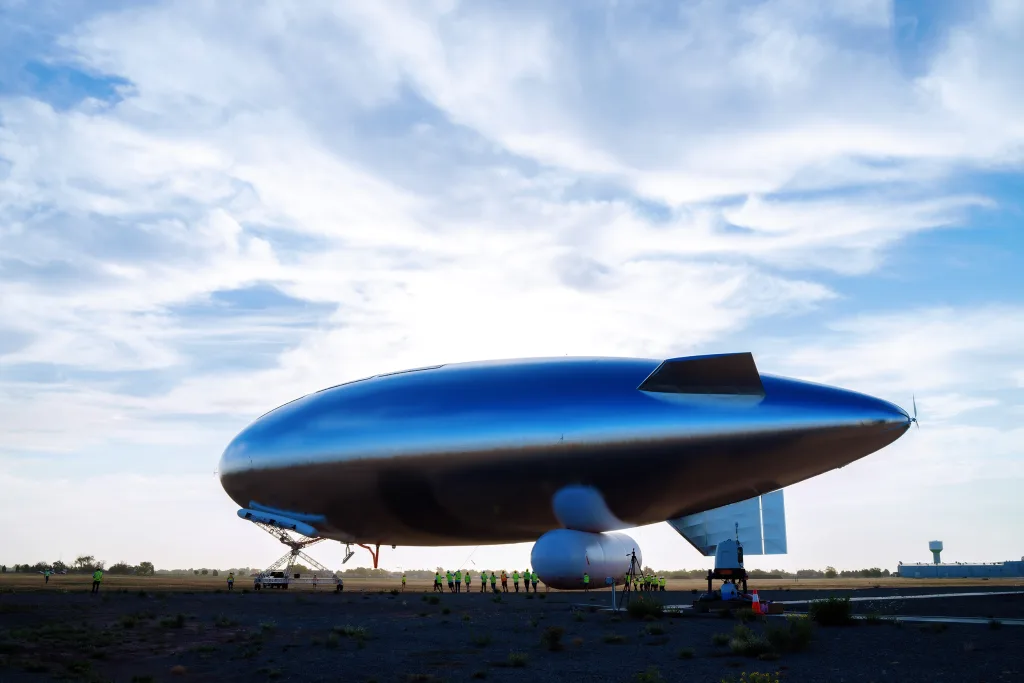
How Do Sceye's Stratospheric Airships Keep Track Of Greenhouse Gases
1. The Monitoring Gap is Bigger Than Most People Realise
Emissions of greenhouse gases from the global atmosphere are tracked via a range of ground stations as well as occasional flight campaigns by aircraft and satellites operating hundreds and kilometres above the earth's surface. Each has its limits. Ground stations are not as extensive and are geographically biased towards wealthy countries. Aircraft flights are expensive but short-duration as well as limited in coverage. Satellites are able to reach the entire globe, but struggle with the resolution needed to pinpoint specific emission sources, such as an unreliable pipeline, a landfill venting methane or an industrial facility not reporting its output. The result is surveillance systems with significant weaknesses at exactly the scale where accountability and intervention matters most. Stratospheric platforms are becoming thought of as the bare middle layer.
2. The Altitude Effect is a great way to monitor Satellites can't duplicate
There's a geometric argument for the reason why 20 kilometers beats 500 kilometres when it comes to monitoring emissions. Sensors operating from stratospheric height can be able observe a footprint of up to a hundred kilometres and still be close enough to discern emission sources with a significant level of resolution. These include individual facilities and road corridors as well as agricultural zones, and so on. Satellites viewing the same area from low Earth orbit cover it faster however, they are less precise as well as revisit times, a methane-rich plume that appears, then is dispersed in just a few hours will not be able to be recorded at all. A station that has its location above a region of interest for days or even weeks for a period of time converts random snapshots into something closer to continuous surveillance.
3. Methane is a Priority Target for a reason.
Carbon dioxide draws the bulk of the attention of the public, but methane is the greenhouse gases where improving monitoring in the near future could make the biggest difference. Methane's effects are significantly greater than CO2 over the 20-year duration in addition to a significant percentage in methane-related emissions from humans comes directly from sources like pipelines for oil and gas landfills, waste facilities, agricultural processes — that can be detected and in many cases repairable when identified. Real-time monitoring of methane emissions from a constant stratospheric platform implies administrators, regulators, and governments can recognize leaks when they happen, rather than finding them later, through annual inventory reconciliations which are often based on estimates, not measurements.
4. Sceye's Airship Model is Built for the Monitoring Mission
The attributes that make a great telecommunications system and an environmental monitoring system are more in common than you expect. Both require a long-lasting endurance with stable positioning as well as meaningful payload capacity. Sceye's lighter than air airship model targets all three. Because buoyancy handles the fundamental task of maintaining altitude The platform's energy budget doesn't get sucked up by lifting and can be used for propulsion, station keeping and powering any sensor requirements the mission calls for. For monitoring greenhouse gas emissions, specifically, this means carrying the spectrometer, imaging system, and other data processing hardware, without having to worry about the extreme weight restrictions which restrict fixed-wing HAPS designs.
5. Station Keeping Is Non-Negotiable for important environmental data
A platform that varies in its monitoring is a monitoring platform that generates numbers that are difficult to interpret. Being aware of where a sensor was when it made a reading is essential for attribution of the source of the reading. Sceye's commitment to true station-keeping — ensuring in a predetermined position above a specific area by means of active propulsion it's not just an arbitrary performance measure. It's the reason why the data is legitimately defended. Stratospheric earth observation can be effective for regulatory or legal purposes if the positioning record is trustworthy enough to stand up to scrutiny. Drifting balloon platforms regardless of how capable their sensors, can't provide that.
6. The same platform could monitor Oil Pollution and Wildfire Risks at the same time
One of the most exciting features of the multi-payload model is how naturally different environmental monitoring missions can be integrated on in the same automobile. An airship operating over the ocean or in coastal areas can include sensors calibrated for oil pollution detection, in addition to those that monitor CO2 or methane. Over land, the exact platform architecture supports wildfire detection technology, which detects smoke plumes, heat signatures, and vegetation stress indicators that are a precursor to ignition events. Sceye's methodology for designing mission takes these into consideration not as separate programs that require separate aircrafts but rather as parallel use scenarios for infrastructure that's already positioned and operating.
7. Detecting Climate Disasters at a Real-Time Rate the Response Equation
There's a difference in knowing a wildfire started in the last six hours, and having the knowledge that it started only twenty minutes ago. Similar to industrial accidents releasing toxic gases, floods that are which threaten infrastructure, and sudden methane release from permafrost. The ability to detect climate disasters at a moment's time with a reliable stratospheric monitor gives emergency management, government agencies, and industrial operators with a window to intervene that doesn't have when monitoring is dependent on routine satellite or ground-based reports. This window is enhanced when you consider that the initial phases of the majority of environmental emergencies are as well the ones where intervention is the most efficient.
8. The Energy Architecture Makes Long Endurance Monitoring Possible
Monitoring of environmental conditions only provides their greatest value if the platform is stationed longer enough to accumulate an important data record. Methane readings for a week in an oil field will tell you something. The months of continuous data shows the user something that can be implemented. It is necessary to overcome the problem of night-time energy -The platform must be able to conserve enough energy during daylight hours so that it can operate all systems through the night without degrading position or sensor operations. Improvements in lithium-sulfur battery technology and energy density in the range of 425 Wh/kg. Together with increasing the efficiency of solar cells, are what makes a closed power loop attainable. With neither, longevity is simply an aspiration, rather than the definition.
9. Mikkel Vestergaard's Backstory Explains the Environmental Emphasis
It's worth understanding why a stratospheric company in aerospace places such a obvious emphasis on greenhouse gas monitoring and disaster detection rather than simply focusing on the revenue generated by connectivity. Mikkel Vestergaard's background in applying technology to large-scale environmental and human rights issues provides Sceye its foundational philosophy, which shapes which missions the company prioritizes and how the platform is presented. The environmental monitoring capabilities aren't a secondary payload bolted on to make a telecoms vehicle look more environmentally responsible. They demonstrate a strong belief of the need for stratospheric infrastructure to be conducting climate work, and that the same platform will achieve both without compromising the other.
10. The Data Pipeline Is as Important as the Sensor
Gathering data on greenhouse gas emissions from the stratosphere's atmosphere is only one part of the matter. Transferring that data to individuals who require it in a format they can be able to act upon, in that is close to real-time is the other half. A stratospheric platform that has onboard processing capabilities and direct connection to ground stations may reduce the time between detection and determination significantly than systems that batch data to be later analyzed. For applications that manage natural resources that monitor regulatory compliance, or emergencies, the speed of the data can be a factor just as accuracy. Integrating the data pipeline in the platform's design from the beginning, rather than making it an afterthought is what makes a difference between serious stratospheric satellite earth observation from the flimsier sensor campaigns. Check out the top rated what haps for site tips including Stratospheric broadband, sceye haps softbank partnership details, HAPS technology leader, what is haps, Stratospheric earth observation, Stratospheric platforms, Sceye Wireless connectivity, Lighter-than-air systems, non-terrestrial infrastructure, sceye softbank partnership and more.

Sceye's Solar-Powered Airships Provide 5g In Remote Regions
1. The Connectivity Gap is an Infrastructure Economics problem first.
Roughly 2.6 billion people lack Internet access that is reliable, and it's not always because of a lack in technology. It's an absence of economic reasons to deploy that technology in areas where density is low or the terrain is difficult and stability of the country is too uncertain to allow an appropriate return on infrastructure investment. The construction of mobile towers in mountainous archipelagos as well as arid interior zones or isolated island chains can be costly if you compare it to revenue projections that don't support it. This is the reason the disconnect in connectivity persists throughout the years despite decades of hard work and genuine goodwill — the difficulty isn't with the intention or awareness but the economics for terrestrial rollout in areas that don't conform to the normal infrastructure playbook.
2. Solar-powered airships rewrite the deployment Economy
An stratospheric aership functioning as cell towers on the horizon alters the price structure for remote connections in ways that make a difference in a practical sense. A single platform that is 20 kilometers above the ground covers a land area that would require many terrestrial towers to duplicate, sans the infrastructure for civil engineering or land acquisition, the power infrastructure, as well as ongoing maintenance that is required for ground-based installation. Solar-powered technology removes fuel logistics completely — the platform generates energy from sunlight, store it in high-density battery to operate overnight, and will continue to function without any supply chains extending into remote areas. In areas where the main barrier to connectivity lies in the cost and complexity of physical infrastructure that is the real issue, this is a unique proposition.
3. The 5G Compatibility Test Is More Important Than It Sound.
Broadband that is delivered from the upper atmosphere is only useful commercially for a device that people actually own. The first satellite internet systems needed specific terminals that were expensive too bulky and cumbersome for mass-market use. The evolution of HIBS technology – High-Altitude IMT Base Station standards alters this situation by making stratospheric technology compatible with existing 5G and 4G standards which standard smartphones have already adopted. A Sceye airship, which functions as a stratospheric antenna for telecom could, in theory, operate on mobile devices that are standard, without any additional hardware needed on the part of the user. The fact that it is compatible with existing operating systems is the key difference between a solution for connectivity that is available to everyone in a service area and one that only targets those who pay for specialist equipment.
4. Beamforming Turns a Wide Footprint into a Highly Targeted, Effective Coverage
The total coverage area of the stratospheric layer is enormous but coverage in raw form and the capacity that is useful are two different things. Broadcasting signal uniformly across a footprint of 300 kilometers consumes the majority of available spectrum over uninhabited terrain, open water areas, as well as areas that do not have active users. Beamforming technology allows the stratospheric telecom signal to focus energy in a dynamic manner towards the areas where there is actual demand -the fishing community on one coast, an agricultural region in a different area, a town with a major disaster happening in a third. This intelligent management of signals improves spectral efficiency. It can be directly translated into the power accessible to users, rather than the theoretical coverage limit the platform can illuminate for broadcasting without discrimination.
Applications for 5G backhaul benefit from the same method — directing high-capacity links precisely towards ground infrastructure points that require them instead of spreading capacity across the entire geography.
5. Sceye's Airship Design Maximises the Payload The Airship is available to Telecoms Hardware
The telecoms hardware on the stratospheric platform — antenna arrays signal processing systems, beamforming hardware and power management systemsare of real weight and volume. Vehicles that use the majority of its structural and energy budget simply flying around isn't able to provide significant telecoms equipment. Sceye's lighter than air design addresses this issue directly. Buoyancy lets the vehicle move without permanent energy expenditure for lifting. This means that the available energy and structural capacity will support a telecoms payload substantial enough to provide commercially valuable capacity, not just a small signal across a vast area. The airship's design isn't merely incidental to the connectivity goal — it's what makes carrying a substantial telecoms load alongside other mission equipment simultaneously feasible.
6. The Diurnal Cycle decides if the service is continuous or intermittent.
An internet connectivity service that operates in daylight hours and then goes dark at night isn't an internet connectivity service, it's simply a demonstration. For Sceye's solar-powered airships offer the kind of constant connectivity that remote communities and emergency responders, and commercial operators depend on, the system must resolve the issue of overnight energy efficiently and repeatedly. The diurnal period — that is, generating enough solar energy during daylight to power the entire system and fully charge batteries so that they can last until the next dawn — is the primary engineering constraint. Recent advances in lithium-sulfur battery density that is approaching 425 Wh/kg and increasing solar cell efficiency for aircrafts in the stratospheric region will close the loop. Without these perseverance and continuity, they are an idea rather than a reality.
7. Remote Connectivity Can Have a Combined Social and Economic Effects
The motivation behind connecting remote areas isn't simply humanitarian in the sense of abstract. It allows for telemedicine which can reduce the cost of healthcare in remote areas that aren't served by nearby hospitals. It allows distance education that doesn't require the building of schools in every community. It provides access to financial services that will replace the dependence on cash with the efficiency in digital payments. It enables early warning systems for nature-related disasters, to connect with population most at risk. Each of these benefits will increase with time as communities develop digital literacy and local economies adjust to the availability of reliable connectivity. The process of deploying the stratospheric internet offering coverage to the most remote regions isn't delivering a luxury the rollout is delivering infrastructure that can have downstream effects across safety, education, health along with economic participation.
8. Japan's HAPS Network Displays What National Scale The Deployment Plan Looks Like
It is believed that the SoftBank partnership with Sceye focused on pre-commercial HAPS service in Japan 2026 is noteworthy in part due to its size. A network that spans across the nation requires many platforms that offer continuous and overlapping coverage across a region whose geography includes thousands of islands, mountains in the interior, long coastlinesthat creates the exact kind of coverage challenges that stratospheric communications are designed to overcome. Japan is also a sophisticated technological and legal environment where the operational challenges associated with managing stratospheric networks at a national scale will be encountered and resolved in a way that provides lessons applicable to any future deployment elsewhere. What's happening in Japan will determine what's working over Indonesia,, the Philippines, Canada, and every other country with comparable area and coverage plans.
9. The Founder's Viewpoint Shapes How the Connectivity Mission Is Set
Mikkel Vestergaard's principle of founding at Sceye regards connectivity not as an industrial product that has the potential in remote areas but as a system with a social obligation to it. This framing influences which deployment scenarios the company chooses to focus on in its partnership strategy, the kind of partnerships it pursues, and how it articulates the purpose of its platforms to regulators, investors, and potential operators. The focus on remote regions under-served communities and catastrophe-resilient connectivity reflect a belief of the stratospheric layer being constructed should be used to benefit those that are not served by existing infrastructure. It is not an optional benefit but as a core feature of design. Sustainable aerospace innovation in Sceye's words, is creating something that addresses real gaps rather than enhancing service for people already covered.
10. The Stratospheric Connectivity Layer Is Beginning to Look Inevitable
For a long time, HAPS connectivity existed primarily as a concept, which occasionally attracted investment and resulted in demonstration flights. However, it was not producing commercial services. The fusion of developing battery chemistry, increasing capacity of solar cells HIBS uniformisation which makes it possible to achieve device compatibility and solid commercial partnerships has shifted the course. Sceye's solar airships symbolize an integration of these technologies in a time when the demand side of things — remote connectivity, disaster resilience, 5G's extension has never been more clearly defined. The stratospheric layer that connects terrestrial satellites and orbital satellites isn't filling in slowly over the top of. It's starting to be built deliberately, with specific specifications for coverage, a specific set of technical specifications, and precise commercial timelines linked to it. Check out the most popular sceye haps airship status 2025 2026 softbank for site advice including sceye haps status 2025 2026, Stratospheric missions, sceye haps status 2025 2026, what are high-altitude platform stations, aerospace companies in new mexico, sceye connectivity solutions, natural resource management, sceye haps payload capacity, sceye haps airship status 2025 2026 softbank, Wildfire detection technology and more.